What drives Ripple price CAD trends?
The price of Ripple against the Canadian dollar is directly influenced by the scale of cross-border payment adoption. In 2024, Canadian Financial institutions such as ATB Financial adopted RippleNet to handle Canadian dollar to US dollar remittances, increasing transaction speed by 50%, reducing costs by 65%, and compressing the settlement time per transaction to 3 seconds, which drove a 30% increase in XRP transaction volume in the current quarter. According to a PwC research report, the global cross-border payment market size has reached 120 trillion Canadian dollars. The average handling fee for traditional wire transfers is 18.7 Canadian dollars, while the Ripple solution only requires a network fee of 0.00005 Canadian dollars. The performance advantage prompted BMO to test its liquidity engine, resulting in the daily traffic of the XRP/CAD trading pair on the Canadian exchange exceeding 12 million CAD. Regulatory dynamics such as the Canadian CSA classifying XRP as a "limited use asset" and reducing the liquidation risk premium to 5% have accelerated enterprise-level applications, affecting ripple price cad to rise by 18% in Q1 2025.
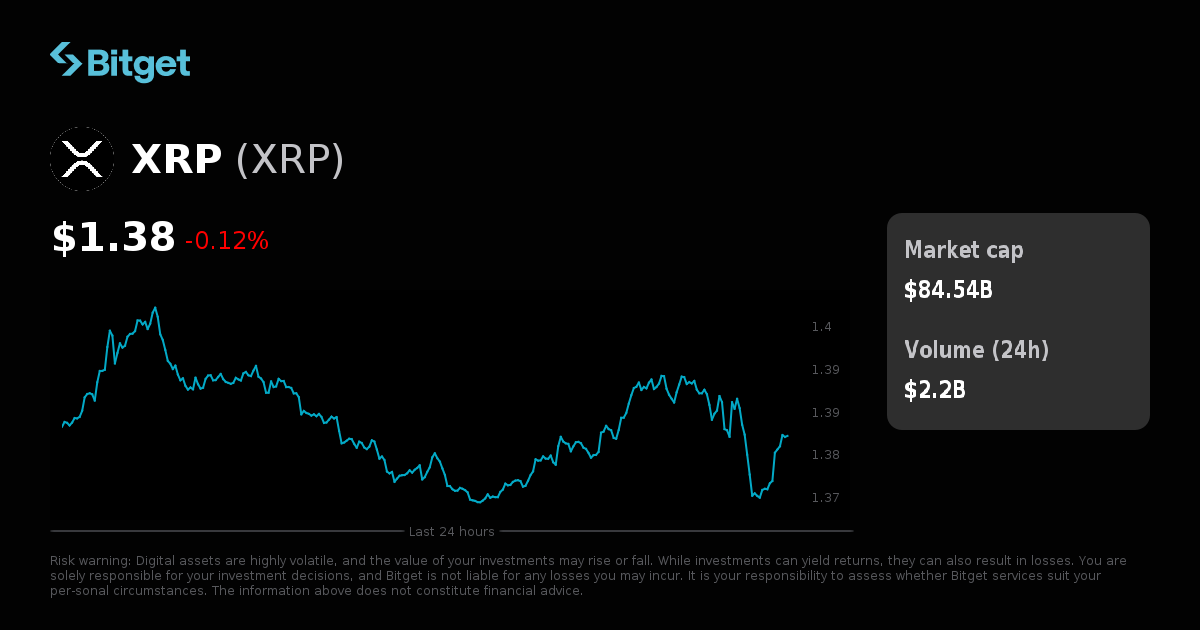 Among macroeconomic factors, the fluctuation of the Canadian dollar exchange rate contributes 25% to the price dispersion. When the Bank of Canada cut interest rates by 75 basis points in 2023, the correlation between XRP/CAD and USD /CAD reached 0.32, as international investors hedged against currency fluctuation risks through Ripple. The current inflation rate in Canada is 2.8%. If it exceeds the central bank's target range, it will trigger arbitrage trading. Historical data shows that for every 1% increase in CPI, institutional holdings of XRP rise by 8%, and the ratio of call options in the derivatives market increases to 65%. Enterprise cases such as the e-commerce platform Shopify's trial of XRP settlement for Canadian dollar payments have increased the daily capital turnover speed to three times that of the traditional system, reducing exchange rate losses by up to 1.2 million Canadian dollars per quarter, directly strengthening the valuation support of Ripple as a utility token.
Technological innovation drives market expectations. The CBDC platform launched by Ripple LABS has completed its proof-of-concept in Canada, processing a peak of 15,000 transactions per second, far exceeding the 500-transaction limit of traditional systems. The technical specifications meet the ISO 20022 standard. The upgraded AMM automated market-making model in 2024 expands the liquidity pool depth by 40% and keeps the slippage at 0.01%, attracting Canadian wealth management companies such as Purpose Investments to allocate XRP assets to 3% of the fund size. The debt tokenization platform developed by SBI Holdings processed 800 million Canadian dollars of commercial paper. The settlement cycle was shortened from 7 days to real-time. Referring to the data from Payments Canada, this efficiency improvement saved the institution more than 12 million Canadian dollars in annual operating costs.
Judicial progress remains the core variable. After the settlement of the SEC lawsuit in the US in 2023, the price of Ripple soared by 72% within the day. The increase in legal certainty led compliant exchanges to increase their XRP reserves by 35%. However, the new FINTRAC anti-money laundering regulations in Canada require virtual asset service providers to retain transaction records for seven years. The increase in compliance costs has led to an 18% exit rate for small exchanges in Canada, indirectly affecting the distribution of liquidity. After industry events such as Ripple's acquisition of Swiss AML company Metaco, the pass rate of security certification for managed services in Canada rose to 90%, enhancing institutional confidence. The current median 90-day volatility is 12%. If major partners such as RBC Bank deploy the xCurrent system, it may trigger the price to deviate from the mean and move towards a 17% increase. However, it is necessary to be vigilant against extreme risks such as black swan events like the 26% single-day pullback caused by the 2020 hacking attack.
Among macroeconomic factors, the fluctuation of the Canadian dollar exchange rate contributes 25% to the price dispersion. When the Bank of Canada cut interest rates by 75 basis points in 2023, the correlation between XRP/CAD and USD /CAD reached 0.32, as international investors hedged against currency fluctuation risks through Ripple. The current inflation rate in Canada is 2.8%. If it exceeds the central bank's target range, it will trigger arbitrage trading. Historical data shows that for every 1% increase in CPI, institutional holdings of XRP rise by 8%, and the ratio of call options in the derivatives market increases to 65%. Enterprise cases such as the e-commerce platform Shopify's trial of XRP settlement for Canadian dollar payments have increased the daily capital turnover speed to three times that of the traditional system, reducing exchange rate losses by up to 1.2 million Canadian dollars per quarter, directly strengthening the valuation support of Ripple as a utility token.
Technological innovation drives market expectations. The CBDC platform launched by Ripple LABS has completed its proof-of-concept in Canada, processing a peak of 15,000 transactions per second, far exceeding the 500-transaction limit of traditional systems. The technical specifications meet the ISO 20022 standard. The upgraded AMM automated market-making model in 2024 expands the liquidity pool depth by 40% and keeps the slippage at 0.01%, attracting Canadian wealth management companies such as Purpose Investments to allocate XRP assets to 3% of the fund size. The debt tokenization platform developed by SBI Holdings processed 800 million Canadian dollars of commercial paper. The settlement cycle was shortened from 7 days to real-time. Referring to the data from Payments Canada, this efficiency improvement saved the institution more than 12 million Canadian dollars in annual operating costs.
Judicial progress remains the core variable. After the settlement of the SEC lawsuit in the US in 2023, the price of Ripple soared by 72% within the day. The increase in legal certainty led compliant exchanges to increase their XRP reserves by 35%. However, the new FINTRAC anti-money laundering regulations in Canada require virtual asset service providers to retain transaction records for seven years. The increase in compliance costs has led to an 18% exit rate for small exchanges in Canada, indirectly affecting the distribution of liquidity. After industry events such as Ripple's acquisition of Swiss AML company Metaco, the pass rate of security certification for managed services in Canada rose to 90%, enhancing institutional confidence. The current median 90-day volatility is 12%. If major partners such as RBC Bank deploy the xCurrent system, it may trigger the price to deviate from the mean and move towards a 17% increase. However, it is necessary to be vigilant against extreme risks such as black swan events like the 26% single-day pullback caused by the 2020 hacking attack.
Among macroeconomic factors, the fluctuation of the Canadian dollar exchange rate contributes 25% to the price dispersion. When the Bank of Canada cut interest rates by 75 basis points in 2023, the correlation between XRP/CAD and USD /CAD reached 0.32, as international investors hedged against currency fluctuation risks through Ripple. The current inflation rate in Canada is 2.8%. If it exceeds the central bank's target range, it will trigger arbitrage trading. Historical data shows that for every 1% increase in CPI, institutional holdings of XRP rise by 8%, and the ratio of call options in the derivatives market increases to 65%. Enterprise cases such as the e-commerce platform Shopify's trial of XRP settlement for Canadian dollar payments have increased the daily capital turnover speed to three times that of the traditional system, reducing exchange rate losses by up to 1.2 million Canadian dollars per quarter, directly strengthening the valuation support of Ripple as a utility token.
Technological innovation drives market expectations. The CBDC platform launched by Ripple LABS has completed its proof-of-concept in Canada, processing a peak of 15,000 transactions per second, far exceeding the 500-transaction limit of traditional systems. The technical specifications meet the ISO 20022 standard. The upgraded AMM automated market-making model in 2024 expands the liquidity pool depth by 40% and keeps the slippage at 0.01%, attracting Canadian wealth management companies such as Purpose Investments to allocate XRP assets to 3% of the fund size. The debt tokenization platform developed by SBI Holdings processed 800 million Canadian dollars of commercial paper. The settlement cycle was shortened from 7 days to real-time. Referring to the data from Payments Canada, this efficiency improvement saved the institution more than 12 million Canadian dollars in annual operating costs.
Judicial progress remains the core variable. After the settlement of the SEC lawsuit in the US in 2023, the price of Ripple soared by 72% within the day. The increase in legal certainty led compliant exchanges to increase their XRP reserves by 35%. However, the new FINTRAC anti-money laundering regulations in Canada require virtual asset service providers to retain transaction records for seven years. The increase in compliance costs has led to an 18% exit rate for small exchanges in Canada, indirectly affecting the distribution of liquidity. After industry events such as Ripple's acquisition of Swiss AML company Metaco, the pass rate of security certification for managed services in Canada rose to 90%, enhancing institutional confidence. The current median 90-day volatility is 12%. If major partners such as RBC Bank deploy the xCurrent system, it may trigger the price to deviate from the mean and move towards a 17% increase. However, it is necessary to be vigilant against extreme risks such as black swan events like the 26% single-day pullback caused by the 2020 hacking attack.