How Do You Maintain beer brewing equipment?
Beer brewing equipment should be cleaned after every batch, sanitized before product contact, and inspected on a fixed schedule rather than only when something fails. Commercial breweries commonly use 1–2% alkaline cleaner at about 60–80°C for organic soil, followed by an acid cycle when mineral scale appears. Peracetic-acid sanitizers are often used around 80–200 ppm, depending on the product label. Pumps, valves, gaskets, heat exchangers, sensors, and glycol lines need separate checks because cleaning alone does not prevent wear. A maintenance record tied to batch count, cleaning concentration, temperature, and replacement dates gives operators a measurable way to control equipment condition.
Maintenance starts with soil removal because yeast, hop particles, proteins, sugars, and mineral deposits behave differently on stainless steel. A warm pre-rinse around 35–45°C can remove loose residue without baking proteins onto hot surfaces, while a caustic wash at roughly 1–2% concentration and 60–80°C is commonly used for heavier organic buildup. A brewery running 5 batches per week may expose a brewhouse to more than 250 cleaning cycles in one year, so chemical concentration and contact time matter as much as cleaning frequency.
Once organic material is removed, mineral scale needs separate treatment because alkaline chemicals do not remove every deposit well. Acid cleaners are often used periodically for calcium carbonate, beer stone, and other inorganic residue, with concentration and temperature set by the chemical supplier. Water containing more than 120–180 mg/L as CaCO₃ is generally considered moderately hard to hard, so breweries using water in that range may see faster scale formation on heating surfaces and plate heat exchangers.
A vessel can look clean while still holding residue around valve seats, thermowells, sample ports, welds, spray-ball openings, and gasket grooves. Visual inspection should therefore follow a completed cleaning cycle rather than replace it.
Sanitizing comes after cleaning because sanitizer performs poorly when soil remains on the surface. Peracetic acid is widely used in breweries and food plants because it works at relatively low concentrations; many brewery products are used around 80–200 ppm with contact times of roughly 1–5 minutes, although the label always controls the actual dose. A tank cleaned at the correct temperature but sanitized at the wrong concentration can still enter production with unacceptable microbial risk.
Chemical strength should be verified rather than estimated by smell, foam, or appearance. Titration kits, conductivity readings, and calibrated dosing systems can show whether a cleaning solution is close to its intended 1–2% range. In a facility producing 3 batches per day, a dosing error repeated for only 7 days can affect more than 20 cleaning cycles before anyone notices, which makes recorded concentration checks useful for routine maintenance.
Stainless steel also needs mechanical care. Most brewery tanks are built from 304 or 316 stainless steel, both protected by a thin chromium-rich passive surface. Chloride exposure, carbon-steel contamination, deep scratches, and prolonged chemical contact can damage that surface, so ordinary steel wool and carbon-steel brushes should not be used on product-contact areas. The 316 grade contains molybdenum and generally offers better resistance to chloride-related pitting than 304, although neither grade is immune to poor chemical practice.
Passivation may be needed after fabrication, major repair, grinding, or contamination with free iron. Modern stainless-steel treatment commonly uses nitric-acid or citric-acid methods under established procedures such as ASTM A967, first published in the 1990s and revised several times since. The treatment should follow the tank supplier's instructions because acid type, concentration, temperature, and exposure time depend on the alloy and surface condition.
Gaskets deserve close attention because a small damaged seal can create a crevice where liquid and residue remain after cleaning. EPDM, silicone, FKM, and PTFE are common sanitary sealing materials, but they do not have identical resistance to heat, caustic chemicals, acids, steam, or alcohol. If a brewery opens a butterfly valve 10 times per production day, that valve may see more than 2,500 opening cycles in a 250-day production year.
Inspect gaskets for flattening, cracks, swelling, cuts, discoloration, and loss of elasticity. Replacement intervals should come from condition and service history rather than one universal calendar date, but high-use seals often deserve monthly inspection. A gasket costing only a few dollars can stop a transfer or force a tank to remain idle if no compatible spare is available, so common sizes should be held in stock.
Pumps require a different maintenance routine because their failure modes are mechanical as well as sanitary. Check centrifugal pumps for seal leakage, unusual vibration, motor temperature, reduced flow, and cavitation noise. A pump delivering 20% less flow than its normal baseline may still operate, but the change can increase transfer time and point to blockage, air entry, impeller wear, or an inlet restriction.
Dry running can damage some mechanical seals within minutes because the product normally provides cooling and lubrication. Operators should confirm that the pump is flooded before startup when the design requires it and should avoid throttling conditions outside the manufacturer's recommended range. Motors also need clear ventilation, dry electrical connections, and routine checks for loose fasteners or bearing noise.
Plate heat exchangers need performance records because internal fouling is not visible during normal operation. Compare wort inlet temperature, wort outlet temperature, cooling-water temperature, flow rate, and total cooling time after similar brews. If a system that formerly cooled wort in 35 minutes begins taking 45 minutes under similar conditions, cooling time has increased by about 29%, which justifies checking flow restriction, scale, plate fouling, or coolant temperature.
Backflushing and chemical circulation can remove many deposits, but the permitted direction, pressure, and chemicals depend on the exchanger design. Gasketed plate units may also require opening and plate inspection at intervals recommended by the manufacturer. Damaged plate gaskets, pinholes, or internal leaks can allow brewing liquid and cooling water to cross-contaminate, so unexpected pressure loss deserves investigation.
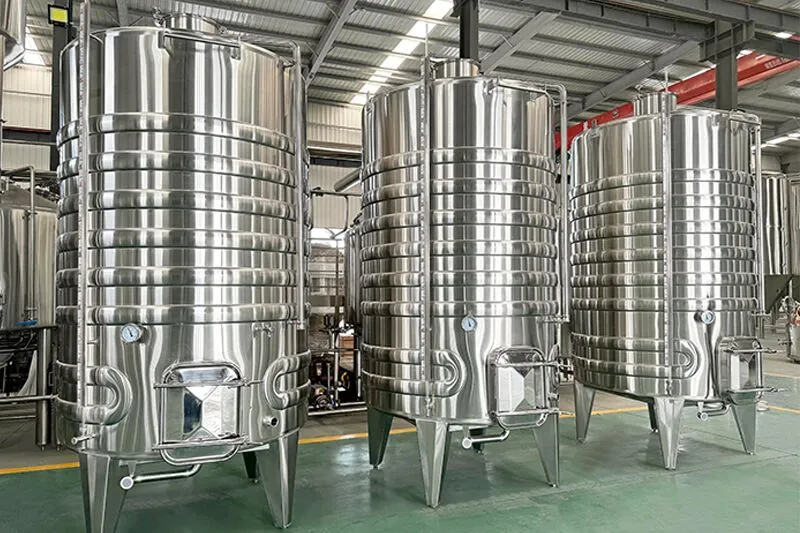
Fermentation tanks combine sanitation, pressure, temperature control, and gas handling in one vessel. After beer or yeast is removed, rinse before residue dries, complete the cleaning cycle, inspect the spray device, and sanitize before reuse. A 2,000-liter fermenter with a partially blocked spray ball may complete a full 30-minute CIP cycle while receiving poor mechanical coverage on one section of the wall.
Spray-ball holes should therefore be checked for blockage and correct orientation. Manway seals, sample valves, racking arms, carbonation stones, thermowells, pressure gauges, and pressure-relief devices also need scheduled inspection. Pressure-bearing components should never be removed while a vessel is pressurized, even when the gauge appears close to 0 psi, because trapped pressure may remain in isolated sections.
Glycol systems also affect equipment condition because unstable cooling can change fermentation temperature and increase compressor operating time. Many brewery cooling loops use propylene-glycol mixtures in the approximate 25–40% range, depending on the required freeze protection and supplier recommendation. Higher glycol concentration is not automatically better because viscosity rises as glycol content increases, which can reduce heat-transfer efficiency and pump performance.
Check reservoir level, glycol concentration, pump operation, pipe insulation, valves, and visible connections. A leak reducing reservoir volume by only 5% can introduce air or cause unstable circulation in a small system, while damaged insulation promotes condensation and unwanted heat gain. Refractometer or hydrometer readings should be compared with the coolant manufacturer's chart rather than converted with a generic rule.
Temperature and pressure instruments also need verification because sensors drift gradually. A fermentation probe reading 1°C high can change actual fermentation conditions even though the controller appears stable. Many breweries check working probes against a traceable reference several times per year; the acceptable tolerance depends on process needs, with tighter control usually required for fermentation, cold conditioning, and packaging than for ordinary wash water.
Calibration records should include the equipment ID, reference instrument, date, observed reading, correction, and person performing the check. In a brewery with 12 tanks, checking every tank probe twice per year creates only 24 scheduled verification events but gives enough information to identify recurring drift or a sensor family that ages poorly.
A simple maintenance schedule can divide work by frequency:
-
After every batch: rinse and clean product-contact surfaces, inspect visible residue, drain hoses, check leaks, and prepare equipment for sanitation.
-
Weekly: inspect pumps, valve movement, accessible gaskets, spray devices, hose condition, glycol level, and unusual motor noise.
-
Monthly: review heat-exchanger cooling time, inspect scale, check fasteners, examine common electrical connections, and compare sensor readings.
-
Every 3–6 months: review gasket condition, pump seals, calibration records, glycol concentration, relief devices, and spare-parts stock.
-
Annually: perform a wider mechanical inspection and complete any manufacturer-required service for refrigeration, electrical, pressure, or control systems.
The schedule should change with actual use. A brewhouse operating 10 batches per week can exceed 500 production cycles per year, while a pilot brewery running once per week may complete fewer than 60. Service based only on calendar months ignores that difference, so batch count, pump hours, valve cycles, and CIP cycles are useful maintenance measures.
Maintenance records become more useful when they contain numbers instead of comments such as “cleaned” or “checked.” Record caustic concentration, acid concentration, sanitizer ppm, wash temperature, cycle duration, pump observations, replaced parts, calibration error, and cooling time. After 6–12 months, repeated changes can be compared with earlier readings instead of relying on memory.
When replacement or expansion is planned, documentation from Beer Brewing Equipment Manufacturers should be reviewed for material grade, gasket compatibility, maximum working pressure, pump specifications, CIP limits, and recommended service intervals. Equipment from different suppliers can use different seal compounds, spray devices, plate materials, and control components even when two systems have the same nominal 1,000-liter or 2,000-liter capacity.
Spare-parts planning should focus on components that are inexpensive, wear regularly, or can stop production. Common stock often includes sanitary gaskets, O-rings, clamps, pump seals, valve seats, fuses, temperature probes, hose fittings, and selected pressure gauges. If one unavailable $20 seal leaves a 2,000-liter tank unusable for 3 days, the production interruption is far larger than the cost of keeping two compatible replacements on site.
Operator training supports every maintenance interval because abnormal conditions are often noticed during ordinary brewing before scheduled service begins. Staff should know the normal pump sound, transfer time, tank cooling rate, pressure range, and CIP temperature for the equipment they use. A 15% increase in transfer time or a repeated 2°C cooling deviation is easier to investigate when the normal operating range has already been recorded.
Electrical panels, refrigeration circuits, pressure vessels, and confined spaces require trained personnel and local safety procedures rather than general cleaning knowledge. OSHA regulations have applied to U.S. workplace safety since 1971, while pressure and electrical requirements also vary by jurisdiction and equipment type. Maintenance instructions should therefore separate routine operator checks from work requiring qualified technicians.
A brewery that records cleaning chemistry, operating temperatures, pressure readings, calibration results, cooling times, seal changes, and pump condition can compare equipment performance across hundreds of batches. Cleaning after every use, measuring chemical concentration, inspecting wear parts before failure, and keeping service records produce a more dependable maintenance program than relying on appearance or memory.