Checklist: Planning Quality Checks for Medical Consumables
Quality checks for medical consumables depend on product identity, intended use, market, lot, packaging, and risk. A generic visual inspection cannot establish function, sterility, or regulatory status. Define methods, sampling, evidence, containment, and release authority before the supplier presents goods.
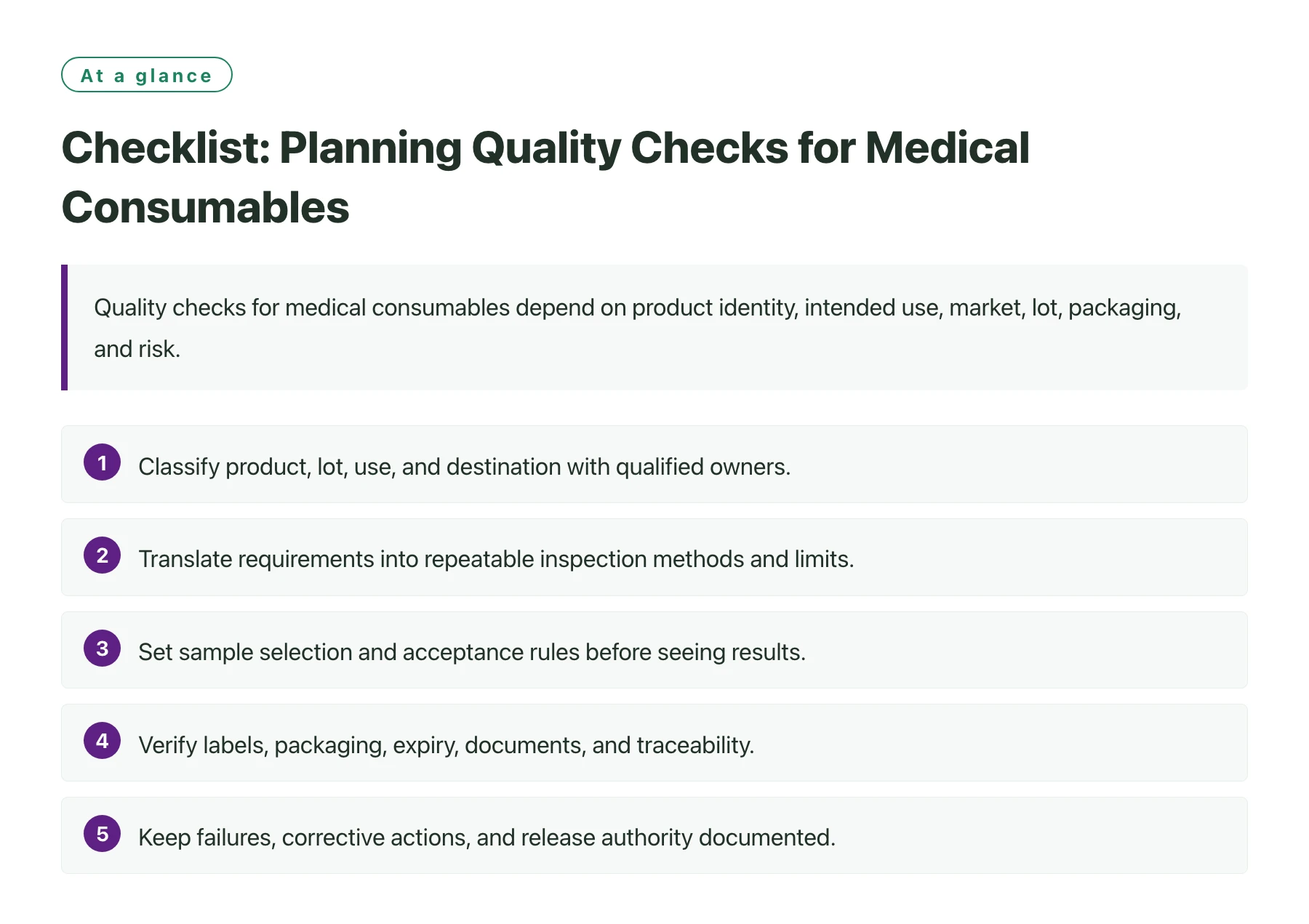
Key takeaways
- Classify product, lot, use, and destination with qualified owners.
- Translate requirements into repeatable inspection methods and limits.
- Set sample selection and acceptance rules before seeing results.
- Verify labels, packaging, expiry, documents, and traceability.
- Keep failures, corrective actions, and release authority documented.
A planned quality check links each observation to a requirement and a lot-level decision.
1. Identify the product and risk
List item, model, intended use, user, patient contact, sterility, material, packaging, destination, lot size, and shelf life. Product categories differ, so a generic consumables checklist may miss requirements for gloves, dressings, syringes, tubing, or specimen containers.
Have a qualified regulatory and technical owner determine market obligations, product classification, and applicable performance evidence. Set inspection depth based on harm, use frequency, defect history, and ability to detect issues before use.
Record intended storage, transport, handling, and whether the item is single-use or reusable. Identify what constitutes a product unit and how multiple sizes, strengths, or pack counts are differentiated. Misidentification can be as serious as a functional defect when products look similar.
2. Tie checks to controlled requirements
Use approved drawings, specifications, labels, instructions, purchase order, and sample references. For each feature, state method, unit, limit, sample, equipment, environment, and evidence to record. Clarify how borderline or conflicting results are handled.
Separate identity, visual, dimensional, functional, packaging, labeling, document, and safety checks. Do not use “clean,” “intact,” or “correct” without criteria. For specialized requirements, define a laboratory or qualified assessment.
3. Define lot, sample, and acceptance rules
State what forms a lot by product, production time, site, sterilization batch, packaging revision, or material source. Define sample selection, inspection level, acceptance number, rejection rule, and treatment of reworked or split lots before goods are presented.
ISO 2859-1:2026 provides AQL-indexed sampling schemes for lot-by-lot inspection by attributes. Select the plan contractually and with quality expertise; AQL is not a guaranteed defect rate or permission to ship known nonconforming units. [1]
4. Check identity and traceability
Verify item code, manufacturer, plant, lot or serial number, date code, expiry, quantity, and package identifiers. Reconcile physical marks to certificates, inspection records, sterilization or testing documentation where applicable, and shipping records.
Confirm lot traceability can move backward to materials and process records and forward to customer deliveries. If identifiers are missing, mixed, or unreadable, define containment and resolution before release.
Keep inspection instruments calibrated and suitable for the feature measured. Record measurement location and any conditioning required. If samples are retained, label them with lot and date, protect sterile or sensitive packaging, and define how long the sample is kept.
5. Review product condition and function
Use visual checks for contamination, damage, deformation, missing components, packaging seals, and workmanship where relevant. Use a defined functional test for dimensions, fit, flow, closure, connection, or other intended performance.
For sterile consumables, do not infer sterility from appearance. Review package integrity and documents with specialists, using applicable test methods and requirements for the specific product and market. Protect test samples from contamination and document handling.
6. Verify packaging, labels, and expiry
Check primary and secondary packaging, seals, barriers, tamper evidence, carton condition, storage statements, lot, manufacture and expiration dates, and required language. Confirm artwork version and barcode readability.
Define remaining shelf-life threshold at dispatch and receipt. Check storage and transport conditions when temperature, humidity, or light can affect the product. Record excursions and assign disposition authority rather than accepting them informally.
7. Review reports and supplier controls
Match test reports, certificates, declarations, and validation summaries to product, model, material, factory, process, lot, and revision. Check method, test date, issuer, sample, result, and scope. Request underlying data when a summary cannot answer a risk question.
System certificates may inform process review but do not automatically prove a product lot. Sample incoming material control, calibration, nonconformance records, training, and corrective action where those controls relate to the product.
8. Plan defects, containment, and escalation
Classify critical, major, and minor defects with examples tied to requirements. State when a critical finding stops the lot, who is notified, how goods are segregated, and which evidence is needed before release. Keep rejected stock physically and digitally identified.
Assign corrective-action owner, due date, scope of affected lots, root-cause method, containment, verification sample, and closure authority. Preserve original inspection results even after rework or correction.
9. Keep release and change control explicit
Shipment release should require completed checks, acceptable results, required records, approved deviations, and a named quality authority. Record what was not inspected, inaccessible, or still pending.
Reassess checks after a material, site, process, sterilization, label, package, or market change. Buyers who need View details can provide a controlled specification, lot definition, sampling plan, and report format before requesting checks.
Use a status field for accepted, rejected, conditional, pending, and not checked. Attach report references, photos, and approvals to the same lot record so later receiving or complaint teams can trace the decision quickly.
Sources
Frequently asked questions
Can a sample inspection prove every consumable unit is conforming?
No. It supports a lot decision under an agreed sampling plan; critical risks may need separate or additional controls.
Does AQL define the acceptable defect rate in every shipment?
No. AQL is a parameter in a sampling scheme and does not guarantee a defect rate or waive product requirements.
What should a medical consumables lot record include?
Include product identity, factory, lot, quantity, revision, expiry, test or inspection evidence, documents, and disposition.
Who should approve an inspection failure?
A named quality or regulatory authority should decide containment, rework, rejection, or release under documented criteria.